

First Commonwealth Financial Corp. /PA/ (FCF), is a Pennsylvania-based financial services company providing a wide array of commercial and consumer banking solutions. With humble beginnings in 1857 as a small loan making institution, it has formed a confluence of history, experience, and excellence that has shaped it into what it is today.
The company thrives on the mission of simplifying financial matters for businesses and individuals by delivering the most suitable banking, insurance, and investment services. As a leading player in the industry, it has developed a strategy to penetrate deeper into the market using an approach built on customer needs, innovation, and market-leading growth.
FCF operates through two segments: The Community Banking segment and the Insurance segment. The Community Banking segment offers traditional banking services, while the Insurance segment offers various insurance products through First Commonwealth Insurance Agency.
The company engages in providing an assortment of commercial banking services including business checking accounts, cash management services, mobile banking solutions, and more. The firm also extends consumer banking services that range from personal checking accounts, savings accounts, loans, debit and credit cards, digital banking, etc.
FCF also provides wealth management services that Indirectly play a crucial role in the economic development of communities. With competent and extensive wealth management services, it helps individuals and businesses to grow financially by giving them access to a variety of investment opportunities.
The insurance services of First Commonwealth give a great deal of importance to risk management. By offering tailor-made insurance solutions, they ensure their clients' exposures are minimized, thereby promoting financial stability.
Despite the challenges that arose from the economic fallout triggered by COVID-19, FCF has maintained a strong and regular performance, which is a testament to its resilience. Their success can be largely accredited to their robust business model, solid capital framework, expense management proficiency, and a diversified revenue stream.
FCF remains dedicated to building relationships within communities they serve, this is reflected in their philanthropic efforts through the First Commonwealth Bank Charitable Foundation. The Foundation contributes to a variety of causes that promote social wellness and benefit communities across Pennsylvania and Ohio.
In conclusion, First Commonwealth Financial Corp. /PA/ is more than just a financial institute. It has positioned itself as a comprehensive financial solutions provider, demonstrating a steadfast commitment to customer service, innovation, and community growth. Their progression over the years has proven their ability to adapt with change and ensures they're greatly poised for sustainable growth in the future.
Income statement
Balance sheet statement
Cash flow statement
Current assets / Current liabilities
Equity / Debt / Cash
Dividends

This article reviews the Q2 earnings performance of regional banks, highlighting First Commonwealth Financial (FCF) and comparing it to peers. FCF reported mixed results with revenue exceeding expectations but the stock declining. OFG Bancorp (OFG) had a strong quarter, while Banc of California (BANC) posted disappointing results, leading to a significant stock drop.
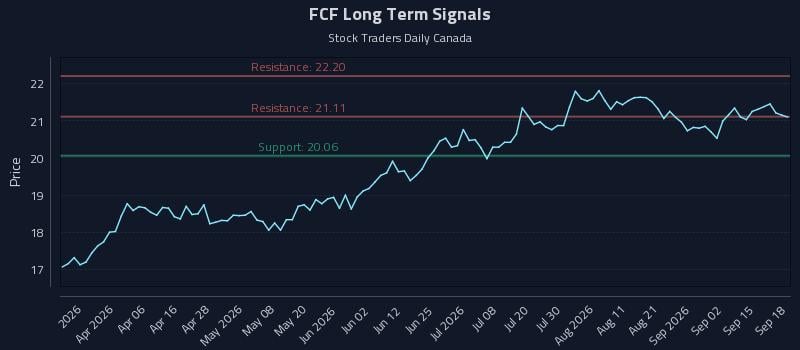
This article analyzes First Commonwealth Financial Corporation (FCF) using AI models to provide trading strategies. Key findings indicate a neutral near- and mid-term outlook that could moderate a long-term positive bias, with resistance currently being tested. The report details position, momentum breakout, and risk hedging strategies, alongside multi-timeframe signal analysis for various holding periods.
Seven analysts have given First Commonwealth Financial Corporation (NYSE:FCF) a "Moderate Buy" consensus recommendation, with an average 12-month price target of $24.25, surpassing its current share price of $21.30. The company recently exceeded quarterly earnings expectations, reporting $0.44 EPS on $139.42 million in revenue. First Commonwealth also offers a quarterly dividend of $0.14 per share, resulting in a 2.6% annualized yield, while institutional investors hold a significant 72.58% stake.
Wellington Management Group LLP significantly reduced its stake in First Commonwealth Financial Corporation (NYSE:FCF) by selling 719,250 shares, retaining 613,323 shares valued at approximately $12.5 million. This divestment occurred in the second quarter, bringing the institutional ownership of FCF to 72.58%. Despite the sale, analyst sentiment remains positive with a "Moderate Buy" rating and a $24.25 average price target, following strong Q2 earnings that surpassed expectations.
First Commonwealth Financial (NYSE:FCF) CFO James Reske sold 2,072 shares of the company's stock for a total of $44,030.00, reducing his position by 2.76%. The transaction was part of a pre-arranged trading plan, leaving him with 73,060 shares. The company recently reported strong quarterly earnings, exceeding analyst expectations for both EPS and revenue, and maintains a quarterly dividend of $0.14 per share, while analysts hold a "Moderate Buy" rating with an average target price of $24.25.
Bank of New York Mellon Corp has acquired 1.08 million shares of First Commonwealth Financial Corporation (NYSE:FCF) for approximately $22.03 million, representing a 1.07% stake. Institutional investors now collectively own 72.58% of the company. Analysts have a "Moderate Buy" consensus rating with an average price target of $24.25, while First Commonwealth Financial also exceeded recent quarterly earnings expectations and offers a 2.7% annualized dividend yield.
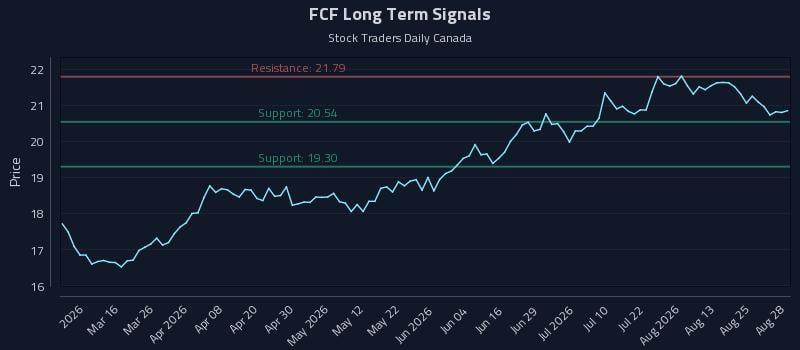
This article analyzes momentum shifts for First Commonwealth Financial Corporation (FCF) using AI models to suggest trading strategies. It highlights a weak near-term sentiment but strong long-term outlook, with a significant risk-reward setup. The analysis provides specific entry, target, and stop-loss levels for position, momentum breakout, and risk hedging strategies, catering to different time horizons.