

Western Union Co (WU) is an American multinational financial services company with headquarters in Denver, Colorado. Founded in 1851 as a telegraph company, it has since evolved into one of the world's largest providers of international money transfer services.
Western Union's primary business is facilitating electronic transfers of money across the globe. Its vast network spans over 200 countries and territories, boasting over half a million agent locations. Meaning, individuals can send or receive funds immediately almost anywhere in the world. This is crucial for migrant workers remitting earnings to their families back home, making the company an essential player in the global economy.
WU also provides ancillary services, such as bill payments for utilities, mortgages, or crediting prepaid cards. Recently, it ventured into digital money transfer, offering apps and a website portal where users can transfer money online. As of recent years, digital transactions have been growing faster than in-person transactions, indicating the company's successful adaptation to the technological era.
Western Union's impact has been crucial throughout history. During the 19th-century American expansion to the west, the company's telegraph network was critical for maintaining communication. In World War II, families and governments used Western Union for telegrams and money transfers. Today, it remains a lifeline for millions of people without access to conventional banking services.
As part of its corporate responsibility, the company makes use of its global reach to address education and disaster response. It created the Western Union Foundation, which provides grants for NGOs worldwide, focusing on economic opportunity and growth.
However, Western Union's services also come with challenges. The company has been scrutinized for exorbitant fees, a lack of transparency in exchange rates, and misuse of its network for money laundering or fraud.
In conclusion, Western Union Co. is a valuable provider of financial services, particularly money transfers, worldwide. Its reach across the globe, coupled with a successful transition to digital, ensures it remains a significant player in the world economy. Yet as with any financial institution, it needs to balance its pursuit of profit with its responsibility towards its customers and the law.
Income statement
Balance sheet statement
Cash flow statement
Current assets / Current liabilities
Equity / Debt / Cash
Dividends
This article provides analyst insights on two financial companies: Progressive (PGR) and Western Union (WU). Bank of America Securities maintained a Buy rating on Progressive with a price target of $230.38, while Citi analyst Bryan Keane maintained a Hold rating on Western Union with a price target of $6.00. The article details analyst ratings, price targets, and their historical performance.

Western Union (NYSE: WU) reported Q2 2026 adjusted revenue of $1 billion, a 1% year-over-year decline, despite a 3% growth in consumer money transfer transactions. The company faces margin pressure from the shift to digital and lower-profit corridors, resulting in adjusted EPS of $0.31, down from $0.42. To counter this, Western Union launched the "Beyond Efficiency" program aiming for $50 million in cost reductions by year-end and is accelerating its "Beyond Digital" platform rollout and digital asset strategy with USDPT.

Western Union (WU) stock has dropped by 4.48% due to an AUSTRAC probe into its oversight of illegal money transfers, including those linked to child exploitation and terrorism financing. This investigation follows a prior audit that found weaknesses in the company's controls, leading to concerns about potential enforcement actions, remediation costs, and reputational damage. Despite the regulatory challenges, Western Union remains profitable with strong cash flow, but the probe has shifted the trading narrative, making it a high-risk situation for investors.
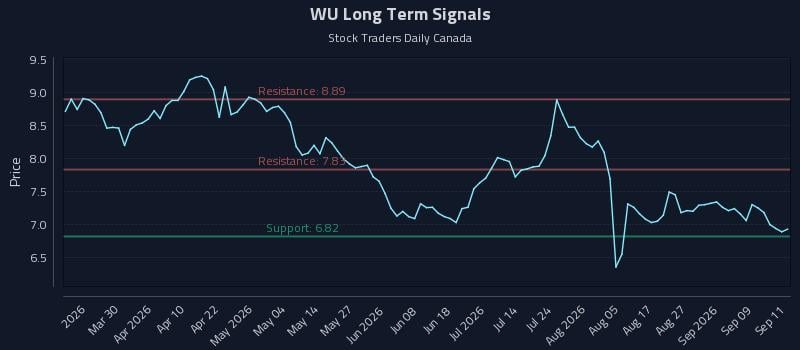
This article provides a detailed analysis of Western Union Company (WU) with a focus on risk zones for precision trading. It highlights weak near and mid-term sentiment, a neutral long-term outlook, and identifies key support and resistance levels. The report also presents three AI-generated trading strategies with specific entry, target, and stop-loss zones for different risk profiles.

Seagate Technology is named Zacks' Bull of the Day due to its strong position in the AI-driven data storage boom, rapidly rising earnings estimates, and a compelling technical setup. Conversely, Western Union is designated Bear of the Day as its legacy money-transfer business faces persistent pressure from digital competitors, tightening immigration policies, and declining earnings estimates. The article also provides a brief analysis of Tesla's mixed August registration trends in Europe and updates on other automakers like BYD and Geely.
Félix, a Miami-based startup using USDC for remittances, raised $200 million, including an $87 million Series C and a $113 million credit facility for a new lending product. This funding round values Félix at $1.4 billion, reflecting its success in processing over $8 billion in remittances across 11 Latin American markets by leveraging stablecoins to bypass traditional banking inefficiencies. However, the company faces new competition as Western Union recently launched "Stablecard," a Visa card backed by a Solana-based stablecoin, effectively closing the stablecoin settlement gap that was Félix's core advantage.

Western Union (WU) closed with a 1.1% dip, underperforming the broader market. Despite a recent 13.84% appreciation over the last month, the company faces projected earnings and revenue declines for the upcoming quarter and fiscal year. Analysts have revised estimates downward, and Western Union currently holds a Zacks Rank of #5 (Strong Sell) with a valuation discount compared to its industry.
Western Union (WU) is gaining attention due to its expanded partnership with Total Wireless, which will broaden the reach of its money transfer, bill pay, and money order services. Despite recent stock price declines, the company's valuation narrative suggests it is about 3.3% overvalued at $7.32 compared to a fair value of $7.09, though its P/E ratio is significantly lower than the industry average. This partnership is seen as part of Western Union's larger digital transformation and efforts to capture the growing market of financially included and mobile-first consumers.