

Blue Bird Corporation (BLBD) is an American manufacturer of school and commercial buses with a comprehensive lineup of Type A, C and D buses in its product range. Founded in 1927, the company is recognized for quality, reliability, and safety that its buses deliver day after day. The company has a long and distinctive history in the bus manufacturing industry, where it is one of the most recognizable and respected names.
The company's headquarters and manufacturing operations are located in Fort Valley, Georgia, where they employ over 1,800 people. The facility in Georgia is not just where Blue Bird’s world-class buses are conceived, designed, and built—it’s also the central hub where the company’s values of integrity, teamwork, and improvement are put into action.
Blue Bird also has a commitment to producing environmentally friendly vehicles, with a belief that clean and efficient alternative fuels are a perfect match for school transportation. The company offers school buses with propane, gasoline, or diesel powertrains, and in 2019, they introduced their first electric-powered school bus.
It is their commitment to quality, safety, and customer satisfaction, as well as their forward-looking approach in environmental sustainability, that set Blue Bird apart. These have propelled the company to become a market leader in the bus manufacturing industry, in addition to a valuable partner to school districts across the U.S. and beyond.
In the stock market, Blue Bird Corporation is listed on the NASDAQ under the ticker symbol "BLBD." Despite inevitable challenges, the company has shown resilient performance in the past, symbolizing its robust nature.
With a tradition as rich and diverse as their product ranges, Blue Bird has always strived to uphold their reputation while evolving with changing times. In the preceding decades since its establishment, the company has repeatedly proved its innovative capabilities by adapting to various changes in industry standards, customer expectations, and environmental regulations.
Blue Bird's vision has always been clear: to inspire generations of students to love the journey in a Blue Bird school bus. With their relentless focus on quality, safety, and customer satisfaction, Blue Bird Corporation has successfully cultivated a legacy that will continue to brighten the future of school transportation for many years to come.
Income statement
Balance sheet statement
Cash flow statement
Current assets / Current liabilities
Equity / Debt / Cash
Dividends
Blue Bird Corporation (NASDAQ:BLBD) has received a "Moderate Buy" consensus rating from nine brokerages, with an average 12-month price target of $85.33, significantly higher than its opening price of $56.35. The company recently surpassed quarterly earnings and revenue expectations. Institutional investors hold a large stake in the company, though a COO recently sold a portion of his shares.

Blue Bird Corp. plans to invest an estimated $300 million to convert a former motorhome manufacturing site in Fort Valley, Georgia, into a 1-million-square-foot school bus factory. This expansion will create 375 jobs over the next three years and will produce Type C school buses powered by diesel, gasoline, propane, and electricity. Construction is expected to begin in the first quarter of 2027, further expanding Blue Bird's existing manufacturing footprint in Peach County.
Redmond Asset Management LLC significantly reduced its stake in Blue Bird Corporation by 69.3% in the third quarter, selling 24,148 shares and retaining 10,699 shares valued at $594,000. Despite this, institutional investors collectively own 93.59% of BLBD, and analysts generally maintain a "Moderate Buy" consensus with an average price target of $85.33. Blue Bird recently exceeded quarterly EPS and revenue estimates and anticipates $4.68 in EPS for the current fiscal year.
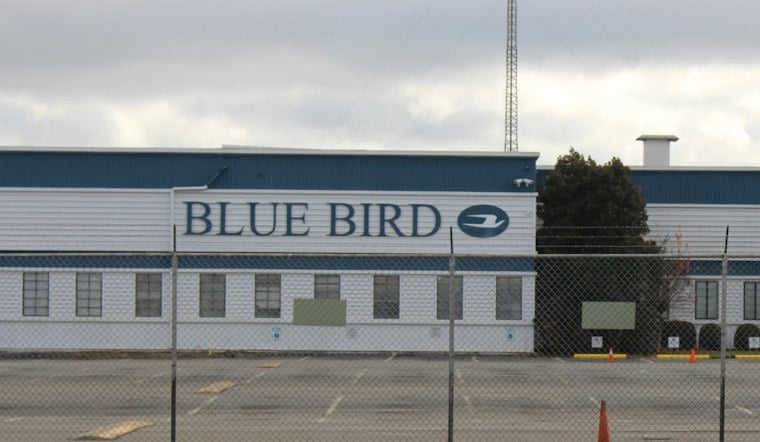
Blue Bird Corporation is investing $300 million into a new 1-million-square-foot manufacturing facility in Fort Valley, Georgia, expected to create 375 jobs over the next three years. This plant will convert a former motorhome site into a facility for building various Type C school buses, including diesel, gasoline, propane, and electric models. This expansion is part of Blue Bird's broader strategy to increase production of electric and alternative-fuel buses, building on previous federal grants for EV manufacturing and contributing to a growing supplier network in Middle Georgia.

Blue Bird Corp., a Macon-based school bus manufacturer, plans to invest approximately $300 million in a new manufacturing facility in Fort Valley, Peach County. This expansion is expected to create 375 jobs, building on the company's long history in the region. The new facility will strengthen Blue Bird's position as one of the nation's largest school bus manufacturers.

Blue Bird Corporation, a major school bus manufacturer, is investing $300 million to convert a former motorhome site in Fort Valley, Georgia, into a 1-million-square-foot facility for producing school buses. This expansion will create 375 new jobs over the next three years, with construction set to begin in Q1 2027. The company, headquartered in Georgia for nearly a century, aims to further its commitment to the community and meet the demand for safe school transportation.
Wall Street analysts are optimistic about Blue Bird (BLBD), with an average brokerage recommendation (ABR) of 1.56, largely driven by Strong Buy ratings. However, Zacks Equity Research advises caution, noting that brokerage recommendations often have a positive bias due to vested interests. The article highlights that Blue Bird currently holds a Zacks Rank #5 (Strong Sell) due to declining earnings estimates, suggesting investors should not rely solely on the ABR.

Blue Bird (BLBD) stock experienced a -2.35% drop in its latest trading session, underperforming the broader market. The company is anticipated to report an EPS of $1.48 and revenue of $548.63 million in its upcoming financial release. Analysts have recently revised estimates downwards, leading to a Zacks Rank #5 (Strong Sell) for Blue Bird, although its valuation metrics like Forward P/E and PEG ratio suggest it's trading at a discount compared to its industry.