

Box, Inc. (BOX), is a leading cloud content management and file sharing service company for businesses. Founded in 2005 by Aaron Levie and Dylan Smith, the company is headquartered in Redwood City, California. Box offers secure, scalable content-sharing and collaboration on any device, allowing individuals and businesses to access, share, and collaborate on their files whenever they want and from any location.
The company started as a simple program designed to allow individuals to securely store and share their files online. Over time, BOX evolved into a more comprehensive, enterprise-level solution offering a host of advanced features, such as secure file, and data encryption, administrative controls, and advanced user management.
Box, Inc. has reshaped the way businesses and teams collaborate, share, and work with their data. Just as the humble office filing cabinet was transformed into an efficient, digital system, Box took it further by allowing that system to become accessible anywhere and anytime.
Box operates on a freemium business model, where it offers a free version with limited storage and features, but users can upgrade to different affordable pricing plans for additional storage and advanced features. It's designed to integrate seamlessly with many other platforms, including Microsoft Office, Google Workspace, Salesforce, and Adobe Sign, making it even more adaptable to the user needs.
In addition to the core features, Box also provides advanced security controls, robust administrative functions, and extensive integration with other apps and services. It is well-positioned to help organizations achieve their digital transformation goals, enhance productivity and streamline their work processes.
What differentiates Box, Inc. from other cloud storage providers is its relentless focus on developing innovative features to improve team collaboration and workflow productivity, putting emphasis on business use over individual use. Furthermore, it prioritizes providing robust data privacy and security measures to ensure users’ content is protected against threats.
Box user base has steadily grown over the years, serving millions of users worldwide and over 97,000 businesses, including 70% of the Fortune 500 companies. Its impressive clientele includes renowned organizations like Coca Cola, GE, Procter & Gamble, and AstraZeneca, demonstrating the platform's versatility and broad capabilities.
As a company, Box has shown persistence in its mission to make it easy for businesses to safely manage their content while fostering a culture of innovation. Its continuous effort to improve, adapt, and maintain its product in the rapidly evolving cloud storage market has helped cement its position as a leading player in the industry.
Income statement
Balance sheet statement
Cash flow statement
Current assets / Current liabilities
Equity / Debt / Cash
Dividends

Barclays PLC has reported a 5.49% beneficial ownership stake in Box Inc Class A common stock, totaling 7,885,799 shares, as detailed in a Schedule 13G filing with the SEC. The filing, dated November 6, 2026, confirms that Barclays PLC holds sole voting and dispositive power over these shares, which were acquired through its subsidiaries Barclays Bank PLC, Barclays Capital Inc, and Barclays Capital Securities Ltd. The event date triggering this disclosure was September 30, 2026.
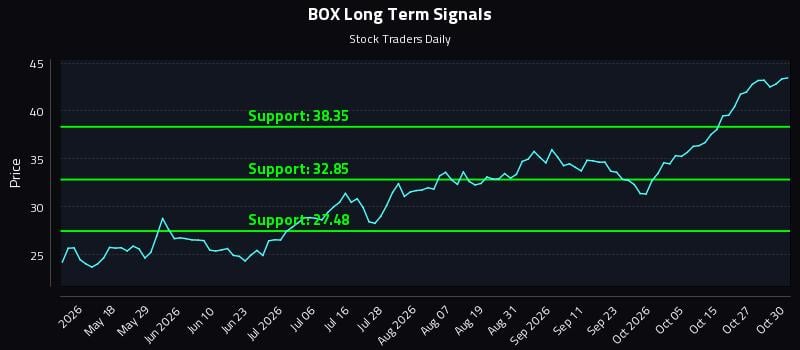
This article provides a precision trading analysis for Box Inc. Class A (NYSE: BOX), indicating a near-term neutral sentiment amidst mid and long-term strength. It outlines three distinct AI-generated trading strategies—Position Trading, Momentum Breakout, and Risk Hedging—complete with entry, target, and stop-loss levels. The analysis also includes a multi-timeframe signal breakdown for support and resistance levels.
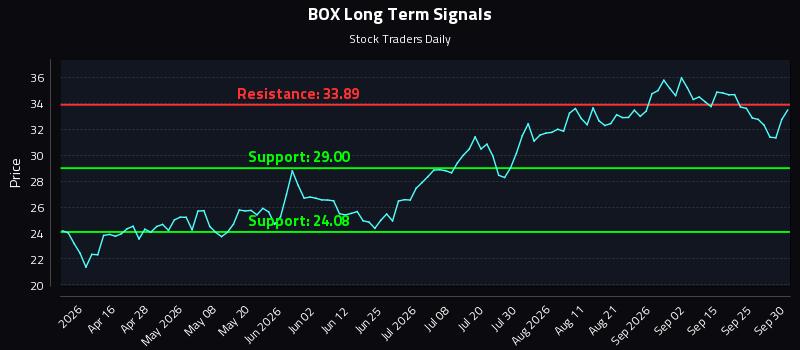
This article from Stock Traders Daily analyzes Box Inc. Class A (NYSE: BOX), highlighting weak near and mid-term sentiment with a neutral long-term outlook. It identifies an exceptional short setup with a high risk-reward ratio and provides AI-generated trading strategies for different risk profiles, including position, momentum breakout, and risk hedging strategies. The analysis includes specific entry, target, and stop-loss levels based on multi-timeframe signal analysis.