

Citi Trends Inc. (CTRN) is a renowned American retail clothing chain specializing in urban fashion and apparel. Founded in 1958, and headquartered in Savannah, Georgia, the company initially began as Allied Department Stores. It was in 2001 that the enterprise was rebranded to its current name, Citi Trends.
Particularly popular among budget-conscious consumers, Citi Trends offers a diverse range of merchandise. This includes everything from clothing for men, women, and children, as well as accessories like jewelry, handbags, and footwear. The brand values trendy and quality products, offering sought-after styles designed for urban consumers, and sources products from across the world.
Citi Trends operates more than 500 stores in over 30 states across the United States, primarily targeted towards African-American and Latino consumers in urban locations. It established an exceptional niche in the market as a go-to place for consumers seeking fashion forward apparel in the urban market at affordable prices. Its ability to keep up with the latest trends and deliver them at cost-effective prices played a key role in making it a preferred destination for many.
Over the years, Citi Trends has marked several milestones. In 2005, the company went public and started trading on the NASDAQ under the symbol CTRN. It has also reinvented its e-commerce presence to cater to digital-savvy consumers, with their online platform becoming a substantial part of their business model.
Citi Trends is known for its commitment to the community. The company often donates a percentage of its profits to charitable organizations and causes it believes in. They make regular contributions to organizations like the United Negro College Fund and The Boys and Girls Clubs of America.
Citi Trends has emerged as a significant player in the retail industry, recognized for its unique selection, affordable prices and impactful community involvement. Facing stiff competition in the market, the company has managed to distinguish itself with its focus on urban fashion. Despite changing times and evolving market trends, the retail company continues to strive, maintaining a strong presence both in the physical and the online retail space. Overall, Citi Trends Inc. is an impactful fashion firm where affordability meets style and trends.
Income statement
Balance sheet statement
Cash flow statement
Current assets / Current liabilities
Equity / Debt / Cash
Dividends

The Canada Pension Plan Investment Board has acquired 14,800 shares of Citi Trends, Inc. (NASDAQ:CTRN) in the second quarter, valuing the new stake at approximately $856,000. This investment represents about 0.18% of the company. Citi Trends recently reported stronger-than-expected quarterly earnings, beating analyst estimates with an EPS of $0.05 against a projected loss of $0.32, while revenue met expectations.
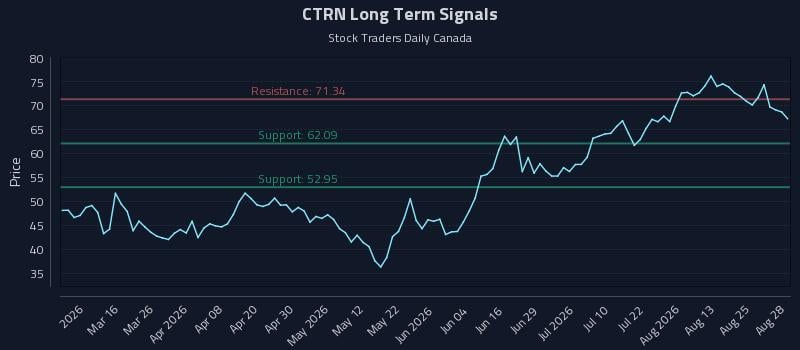
This article provides a price-driven insight for Citi Trends Inc. (CTRN), highlighting a weak near and mid-term sentiment but a strong long-term outlook. It details three AI-generated trading strategies—Position, Momentum Breakout, and Risk Hedging—along with multi-timeframe signal analysis, including support and resistance levels. The report emphasizes an exceptional risk-reward short setup with a 44.0:1 ratio.

Citi Trends reported better-than-expected fiscal Q2 2026 earnings, with a smaller loss and higher revenue than forecasts, driven by strong comparable store sales growth. Despite raising its full-year guidance, the company's shares fell, suggesting investors may have anticipated even stronger results or a larger outlook boost. Management highlighted consistent execution, positive sales trends across categories, and strategic initiatives for future growth and profitability.

Citi Trends (NASDAQ: CTRN) exceeded its second-quarter earnings and revenue forecasts, reporting a loss of $0.11 per share against an expected $0.35 loss, and revenue of $211.6 million against an expected $205.5 million. Despite this strong performance and a raised full-year outlook, shares dipped 1.82% pre-market, possibly due to a reduced store-opening target for fiscal 2026. The company maintained robust comparable sales growth and significantly improved profitability, with first-half adjusted EBITDA already surpassing the total for fiscal 2025.