

Denali Therapeutics Inc., also recognized by its ticker DNLI, is a publicly traded biopharmaceutical company that specializes in developing treatments for neurodegenerative diseases. The company was founded in 2013 by former Genentech executives Ryan Watts, Alex Schuth, and Marc Tessier-Lavigne. It is currently headquartered in South San Francisco, California.
The mission of Denali Therapeutics is to conquer degeneration, aiming to deliver effective treatments for neurodegenerative diseases that are known to cause significant suffering for patients and their families. These diseases range from Alzheimer's and Parkinson's to ALS (Amyotrophic Lateral Sclerosis) and other rare genetic disorders of the nervous system.
Denali's approach to tackling these diseases is cutting-edge and multi-faceted. Focused on overcoming the blood-brain barrier, which has been a longstanding obstacle in treating neurological diseases, Denali uses its proprietary technology called the Transport Vehicle (TV) platform. This technology allows therapeutic proteins and other drugs to cross the blood-brain barrier and directly target the disease-causing activities in the brain.
Denali Therapeutics’ portfolio includes multiple ongoing clinical trials in varied stages, with several drugs for Parkinson's Disease, Alzheimer's Disease, ALS, and other neurodegenerative disorders. Denali has also built partnerships with household names in pharmaceuticals such as Biogen and Takeda, working collaboratively to develop therapeutic treatments using its signature technology.
As a publicly-traded company on NASDAQ since 2017, Denali has shown commitment and potential in its pursuit. It continues to be a promising enterprise in biopharma, attracting investor attention with its progress and innovative approach to neurological degenerative disease treatment. Denali's transparent commitment to therapeutic research and development, along with its effort to decode and defuse some of the most challenging neurologic disorders, places it at the forefront of biopharmaceutical innovation.
However, biopharmaceutical research and development is inherently risky, with high costs and no guarantee of success. Therefore, while the goals of Denali Therapeutics are laudable and its work's potential immense, financial success is far from assured. Nevertheless, Denali's dedication to overcoming some of the most significant challenges in neurodegenerative disease treatment makes it a noteworthy player in the wider biopharmaceutical sector.
Income statement
Balance sheet statement
Cash flow statement
Current assets / Current liabilities
Equity / Debt / Cash
Dividends

Denali Therapeutics reported strong Q2 2026 financial results, highlighted by $3.6 million in net product revenue for its new therapy, Avlea, during its first full commercial quarter. The company also advanced two Alzheimer's disease programs (DNL628 and DNL921) into clinical development, with initial data anticipated in 2027. Denali maintains a robust financial position with over $1.1 billion in cash and securities, and expects Q3 net product revenue for Avlea to be between $10 million and $12 million.
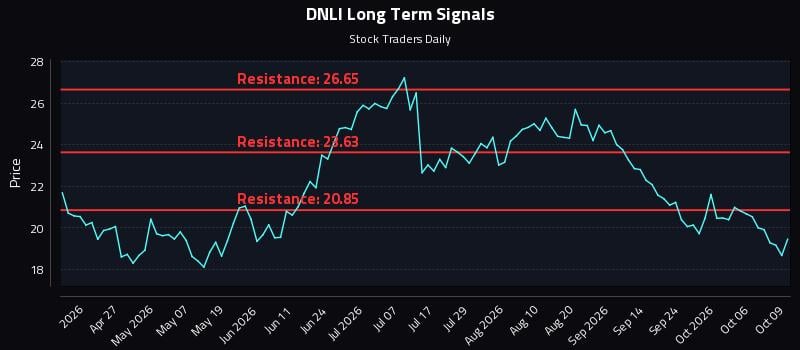
Denali Therapeutics Inc. (NASDAQ: DNLI) is showing weak near and mid-term sentiment, which could challenge its long-term positive outlook. The article provides AI-generated trading strategies including position trading, momentum breakout, and risk hedging, along with multi-timeframe signal analysis indicating support and resistance levels.

Denali Therapeutics (DNLI) has seen a mixed share price performance, with recent gains contrasting a weaker long-term trend. The company's valuation is currently being assessed against its future cash flow potential, particularly given its heavy investment in neurodegenerative disease treatments and current cash outflow. A Discounted Cash Flow (DCF) analysis suggests the estimated intrinsic value is in line with the current market price, prompting investors to consider whether the projected shift from cash burn to consistent inflows is achievable.