

DYCOM Industries Inc. (NYSE: DY) is a leading specialty contracting firm offering a comprehensive suite of services to the telecommunications and infrastructure industry. The company, headquartered in Palm Beach Gardens, Florida, primarily provides program management, engineering, construction, maintenance, and installation services for telecommunications providers across the United States. Incorporated in 1969, DYCOM has grown into a well-respected name in the industry, renowned for its expertise and depth of experience.
DYCOM has a competitive edge in the industry due to its robust customer base, comprising mainly of large and reputable telecommunications companies such as AT&T, Comcast, Verizon, and a host of others. The company has been a pivotal part of the ongoing expansion and upgrade efforts in the telecommunications infrastructure, assisting many telecommunications companies in ensuring that their networks are up-to-date and fully functional.
Like many other companies, DYCOM faced challenges during the COVID-19 pandemic but has managed to maintain stable operations, proving its resilience and strategic capabilities as a business. The company has adapted to the unprecedented business environment, maintaining high health and safety standards for its employees and clients. In doing so, it has reaffirmed the trust and confidence of its shareholders and stakeholders in its resilience and management.
With its geographical reach, the company covers a wide array of locations in the US. Moreover, they also provide underground utility locating services and various services in Canada under the Valard brand. DYCOM Industries Inc. continues to carve a niche for itself in this demanding sector, making it an essential player in the industry.
Financially, DYCOM's continued growth in the industry is reflected in its performance with a steady stream of revenues and profitability. Even in periods of economic uncertainty, the company has managed to maintain a considerable cash flow that has allowed it to invest in necessary strategic investments.
DYCOM's commitment to offering its services through various subsidiaries has played a substantial role in its successful operations. Some recognized names include Goodman Networks, McNichols trenching service, and Sigma Communications. Through these subsidiaries, DYCOM provides a full spectrum of services necessary for the construction and maintenance of complex telecommunications infrastructure.
In conclusion, DYCOM Industries Inc. stands as a significant figure in the telecommunications infrastructure industry. With its long years of experience, robust performance, and expansive reach, along with an impressive client base, the company has proven that it possess the mettle and adroitness to continue leading in this sector. Therefore, DYCOM is poised to capture the growth opportunities that will result from the continuous development of the telecommunications and infrastructure industry in the United States. DYCOM is the preferred partner of choice for many telecommunications providers seeking to upgrade their networks, and the company looks set to maintain this status going forward.
Income statement
Balance sheet statement
Cash flow statement
Current assets / Current liabilities
Equity / Debt / Cash
Dividends

Dycom Industries, Inc. presented at D.A. Davidson's 25th Annual Diversified Industrials & Services Conference on September 24, 2026, at 8:00 AM. The article provides a transcript of the presentation, featuring an analyst's introduction. Other recent news includes insider share purchases, UBS adjusting price targets, and the company's equity buyback plans and updated earnings guidance for fiscal year 2027.
An insider at Dycom Industries recently purchased shares valued at $252,246, as detailed in a recent SEC filing. This transaction occurred on September 9, 2026. The article notes that access to the full details is restricted to members.

David Joseph Fallon, a Director at Dycom Industries (NYSE:DY), purchased 700 shares of common stock for $201,000 on September 1, 2026, significantly increasing his direct stake in the company. This transaction is viewed as a bullish signal by the author, especially given the company's strong performance in 2026 and a unanimous "buy" rating from analysts with high price targets. Despite this, Dycom Industries was not among The Motley Fool Stock Advisor's top 10 stock picks.
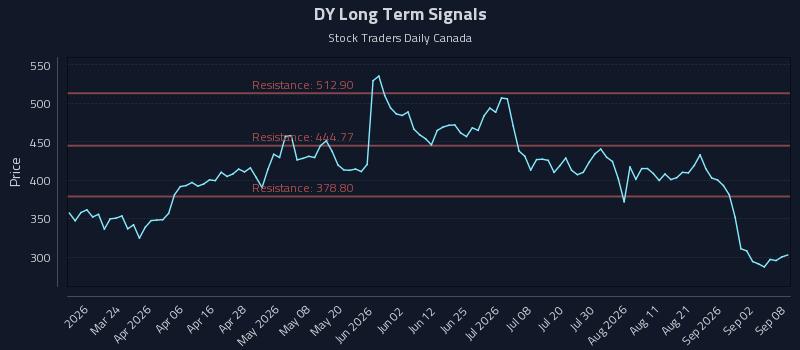
This article analyzes Dycom Industries Inc. (NYSE: DY) stock, noting positive near-term sentiment within a long-term strength context, despite a weak mid-term bias and elevated downside risk. It provides AI-generated institutional trading strategies including position trading, momentum breakout, and risk hedging, along with multi-timeframe signal analysis for tactical traders.
Shares of Dycom Industries (DY) have declined 34% over the past three months, yet the company boasts a record backlog and raised fiscal 2027 revenue outlook, supported by strong demand for fiber infrastructure. While near-term margin pressures in Communications and wireless revenue deferral pose challenges, growth opportunities in long-haul fiber, data centers, and Building Systems are expected to drive long-term prospects. Investors are advised to maintain a cautious stance due to these mixed signals.

Dycom Industries (NYSE:DY) has reported strong quarterly results and raised its full-year outlook, yet its share price has declined, creating a valuation debate. The company benefits from long-term trends in fiber deployment, broadband expansion, and data center connectivity, driven by increasing demand for high-speed internet and AI infrastructure. However, risks such as customer concentration and project timing delays, coupled with a premium valuation compared to peers, contribute to market uncertainty despite the positive operational performance.

Dycom Industries (DY) stock has experienced 11 consecutive days of decline, resulting in a 34% loss of its value and erasing $4.4 billion from its market capitalization. This significant drop is company-specific, occurring while the S&P 500 saw a much smaller decline. Despite strong revenue growth, the company's operating margin is below the S&P 500 median, and its P/E ratio is slightly above the S&P 500 median but below the industrials sector median, prompting a re-evaluation of its fundamentals and highlighting the importance of diversification.