

National Fuel Gas Company (NFG) is a multi-billion dollar integrated energy company with a history that dates back to over a century. Founded in 1902, the company is headquartered in Williamsville, New York, USA. NFG operates as a diversified energy organization involved in several aspects of the oil, gas, and power generation industries. It's among the earliest utilities in the United States, setting the standard for reliable energy supply and exceptional customer service to over 740,000 customers.
Across its diversified business segments, National Fuel Gas Co has strengths that spread across exploration and production, pipeline and storage, gathering, utility, and energy marketing. It has an extensive network that stretches across approximately 30,000 miles of pipeline, with notable robust operations in the Appalachian region, including the prolific Marcellus Shale.
Its Exploration and Production operations are carried out in California and in the Appalachian region through Seneca Resources Company, LLC. NFG’s operations in these regions involve seeking, developing, and producing natural gas and oil reserves.
When it comes to the Pipeline and Storage segment, the company owns an integrated gas pipeline system that extends over 2,500 miles from Southwestern Pennsylvania to almost the Canadian border in the Eastern United States, transporting both its own and third-party natural gas.
On the other hand, through the utility arm, National Fuel Gas Distribution Corporation, the company sells or transports natural gas to its customers in upstate New York and Pennsylvania. Equally, it has an Energy Marketing segment through National Fuel Resources, Inc., which markets natural gas to industrial, commercial, public authorities, and residential end users in upstate New York.
NFG also boasts of its Gathering segment through Empire Pipeline Inc., which constructs and maintains gathering pipelines and compressor stations that gather natural gas from the Marcellus Shale region and transports to local distribution companies, utilities, and other pipelines.
Through its operations, National Fuel Gas Co has demonstrated its commitment to operational excellence, environmental responsibility, customer service, and community involvement. Unsurprisingly, it has sought to adapt its practices to be more sustainable and to reduce the environmental impact of its operations.
Whether it's their role as a reliable utility operator, an efficient energy provider, or their commitment to the communities in which they operate, National Fuel Gas Co continues to prove why it has been a mainstay in the American energy sector for over a century.
Income statement
Balance sheet statement
Cash flow statement
Current assets / Current liabilities
Equity / Debt / Cash
Dividends
ProShare Advisors LLC increased its stake in National Fuel Gas Company by 7.1% during the third quarter, purchasing 22,077 shares and bringing its total holdings to 331,089 shares valued at $25.1 million. Institutional investors now own nearly 74% of National Fuel Gas. The company also declared a quarterly dividend of $0.555 per share, resulting in an annualized dividend yield of 2.8%.
Cantor Fitzgerald Investment Advisors L.P. has significantly increased its stake in National Fuel Gas Company (NYSE:NFG) by 75.5%, adding 39,479 shares to now hold a total of 91,770 shares valued at $6.96 million. This acquisition highlights institutional confidence in National Fuel Gas, which recently reported strong quarterly earnings of $1.54 per share, surpassing estimates, and declared a quarterly dividend of $0.555 per share. Analysts maintain a "Moderate Buy" consensus rating with an average price target of $105.50, indicating potential upside from its current share price of $79.31.

National Fuel Gas (NFG) has seen significant share price growth, and its planned 2027 breakup into two separate companies raises questions about its current valuation. A Discounted Cash Flow (DCF) analysis suggests the stock is meaningfully undervalued based on its projected cash flows, which are expected to grow over the next decade. The market's current pricing may reflect uncertainty surrounding the upcoming separation.
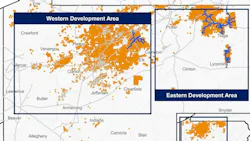
National Fuel Gas Co. plans to spin off its Appalachian natural gas division, Integrated Upstream and Gathering (IUG), by the second half of 2027. This separation aims to allow investors direct exposure to the growth of Appalachian natural gas and enable IUG to pursue a faster development pace. IUG, which produces about 1.1 bcfd and holds 5 trillion cu ft of proved natural gas reserves, will be led by Justin Loweth.
National Fuel Gas (NFG) has announced a significant restructuring plan to separate its Upstream and Gathering business from its pipeline, storage, and utility operations. The company is currently trading at US$79.92, which Simply Wall St considers undervalued with a fair value of $93, based on projected annual EPS growth, free cash flow, and a shift towards regulated earnings. The success of this restructuring and the integration of the Ohio gas utility will be crucial in determining if the perceived undervaluation holds true.
National Fuel Gas (NFG) announced a major restructuring plan to separate its Upstream and Gathering business from its pipeline, storage, and utility operations. While long-term shareholders have seen rewards, the company's valuation of $79.92 (against a fair value of $93) suggests it is undervalued, relying on successful execution of its Ohio utility integration and upstream development to close this gap. The market awaits to see if the restructuring will unlock further upside or if the rerating has already occurred.
National Fuel Gas Co. plans to spin off its Integrated Upstream and Gathering (IUG) business into a separate publicly traded company, creating two distinct entities. The separation, expected in the second half of 2027, aims to provide each company with greater flexibility for capital allocation and growth while preserving operational efficiencies. Post-split, National Fuel will focus on regulated natural gas utility, pipeline, and storage operations, while IUG will concentrate on natural gas production and gathering in the Appalachian region.