

Nuveen Variable Rate Preferred & Income Fund (NPFD) is a diversified, closed-end, value-oriented investment fund managed by Nuveen, one of the leading global investment management firms with over $1 trillion in assets under management. The fund was created to cater to conservative income-focused investors wanting a regular income source through diversified investments with minimum risks.
Nuveen employs its proprietary research-driven investment process to make informed decisions pertaining to NPFD. The fund primarily invests in adjustable rate preferred securities and floating rate senior loans. The objective is to provide high current income and capital appreciation on a risk-adjusted basis. Floating rate securities help in reducing interest rate risk exposure. They offer reduced sensitivity to jumps in interest rates, thereby protecting capital amidst experiencing increased returns in a rising rate environment.
A key feature of NPFD is responsible investing. Nuveen is known for integrating environmental, social, and governance (ESG) principles into its overall investment approach. The idea is not only to generate income and capital gains for investors but also to achieve a positive societal impact.
Moreover, NPFD uses a leverage strategy where it borrows capital at a lower rate and invests it in high-interest yielding instruments. When executed properly, this strategy can boost the fund's earnings, resulting in more dividends for shareholders.
NPFD offers financial advisors and individual investors with the option of regular income distribution, which can either be reinvested or paid out in cash, thereby providing a steady stream of income, particularly favorable for retirees or those looking to supplement their regular income.
NPFD's portfolio primarily includes adjustable rate preferred securities, senior corporate loans and bonds, multilateral development bank securities, collateralized loan obligations, and corporate bonds or notes, thus providing a diversified investment portfolio.
In summary, Nuveen Variable Rate Preferred & Income Fund is an investment product that provides investors with the opportunity to earn income and capital appreciation, primarily through investments in variable-rate securities that have the potential to benefit from rising interest rates. It is an excellent choice for income-seeking investors with moderate risk appetite who are looking for capital preservation along with income generation and diversification.
However, it's important to remember that all investments carry some level of risk and past performance is not indicative of future results. Therefore, potential investors should consult their financial advisors before investing in NPFD or any other investment products.
Income statement
Balance sheet statement
Cash flow statement
Current assets / Current liabilities
Equity / Debt / Cash
Dividends
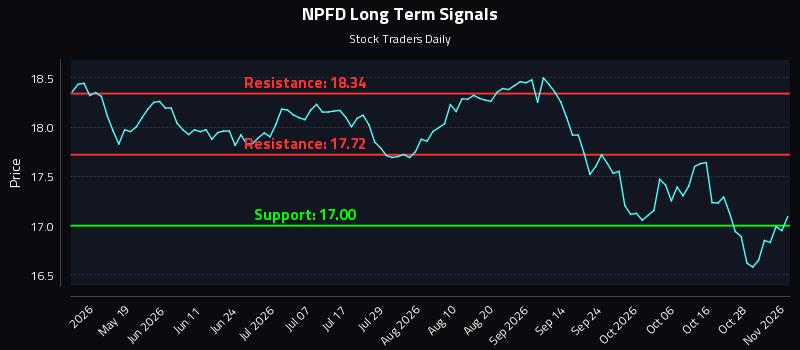
This article analyzes Nuveen Variable Rate Preferred & Income Fund (NASDAQ: NPFD), highlighting divergent sentiment readings and a potential test of support. It provides three AI-generated institutional trading strategies—Position Trading, Momentum Breakout, and Risk Hedging—with specific entry, target, and stop-loss levels. The analysis also includes a multi-timeframe signal breakdown for near-term, mid-term, and long-term horizons.

Nuveen Variable Rate Preferred & Income Fund (NPFD) is expanding its investment policies to allow up to 10% of managed assets in non-U.S. dollar denominated securities and gain exposure to Regulation S and TEFRA-restricted fixed income via Cayman Islands subsidiaries. This move significantly broadens the fund's portfolio scope and international reach, allowing it to invest up to 25% of total assets in a TEFRA Bond Subsidiary and hold additional contingent capital securities. The fund is also supplementing its principal risk disclosures to address foreign currency, Regulation S securities, TEFRA bond, and subsidiary-specific risks.

Nuveen Variable Rate Preferred & Income Fund (NPFD) has established two wholly owned Cayman Islands subsidiaries to expand its investment capabilities into Regulation S securities and TEFRA Bonds, effective October 19, 2026. This strategic move also includes updates to its investment policies, such as allowing non-U.S. currency exposure up to 10% of managed assets and adding new principal risk factors related to these changes. The subsidiaries will continue to be advised by Nuveen Asset Management, LLC.

This article provides an analysis of Nuveen Variable Rate Preferred & Income Fund (NASDAQ: NPFD), highlighting strong near-term sentiment despite a neutral mid and long-term outlook. It identifies a mid-channel oscillation pattern and offers three distinct AI-generated trading strategies: Position Trading, Momentum Breakout, and Risk Hedging, along with multi-timeframe signal analysis for various horizons. The analysis includes specific entry zones, targets, and stop losses, emphasizing risk management.
This article analyzes Nuveen Variable Rate Preferred & Income Fund (NPFD), highlighting strong near-term sentiment with a neutral mid and long-term outlook. It details an exceptional 12.6:1 risk-reward setup targeting a 3.6% gain against 0.3% risk. The analysis also provides three distinct AI-generated trading strategies—Position, Momentum Breakout, and Risk Hedging—along with multi-timeframe signal analysis for support and resistance levels.
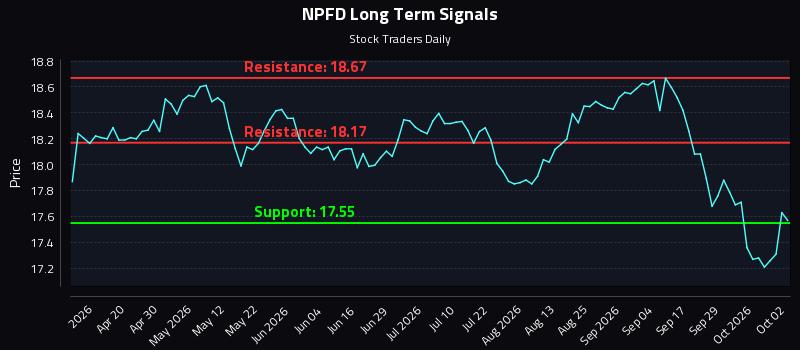
This article analyzes Nuveen Variable Rate Preferred & Income Fund (NASDAQ: NPFD) through AI models, highlighting divergent sentiment across time horizons and presenting three institutional trading strategies: Position Trading, Momentum Breakout, and Risk Hedging. It also provides multi-timeframe signal analysis, including support and resistance levels, and encourages users to access real-time signals and analysis tools.
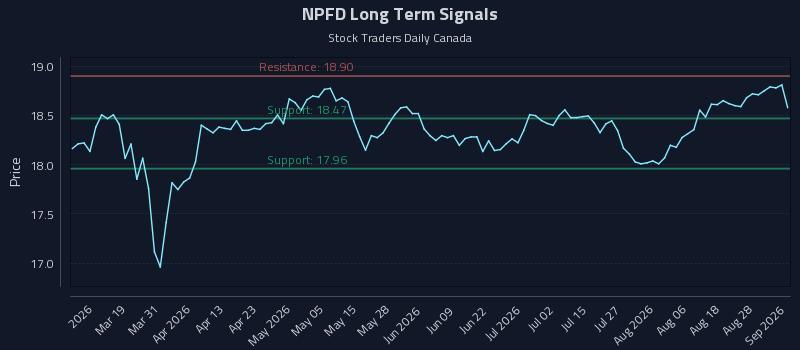
This article provides a real-time signal analysis for Nuveen Variable Rate Preferred & Income Fund (NPFD), indicating a neutral sentiment across all time horizons. It outlines three distinct AI-generated trading strategies: a position trading strategy, a momentum breakout strategy, and a risk hedging strategy, each with specific entry, target, and stop-loss levels. The analysis highlights an exceptional 8.6:1 risk-reward setup targeting a 2.3% gain versus 0.3% risk.