

Alpine Income Property Trust, Inc. (PINE), is a publicly traded real estate company that specializes in the acquisition and ownership of high-quality single-tenant net lease commercial properties. It was incorporated in 2019 and had an impressive IPO. The Daytona Beach, Florida-based company was formed by CTO Realty Growth, Inc. and operates under external management guided by the same executive team at CTO.
Alpine properties are leased to a diverse base of retail, industrial, and office tenants. As of 2021, Alpine Income Property Trust's portfolio includes over 50 properties in the United States spread across 17 different states.
As of its portfolio's properties, one of the main investment criteria for PINE is the opportunity for rental escalations during the term of each lease. This ensures an increasing income flow over a period of time. The company also prefers properties situated in markets with decent population growth, strong demographics, or higher than average projected job growth.
The business model of Alpine functions on the net lease model which refers to the tenants being responsible for various expenses such as maintenance costs, insurance, and taxes, rather than the landlord, which in this case is PINE. Such an approach guarantees Alpine a steady stream of rental income without having to bear the burden of property expenses.
In terms of financial performance, Alpine Income Property Trust's revenue continues to grow at a steady pace. The company's disciplined capital allocation strategy, strong portfolio quality, and experienced management team facilitates this growth and increases the value for shareholders.
Furthermore, Alpine Income Property Trust presents a promising option in the commercial real estate space for the investor willing to take on a bit more risk for potentially strong returns. The landscape of commercial real estate investment trusts (REITs) is vast, with companies ranging in size and focus, but Alpine's focus on well-located, net-leased properties might make it a solid choice in a tumultuous economy.
In conclusion, Alpine Income Property Trust, Inc. represents a consistent and reliable option in the REITs market, leveraging on its disciplined and tactical approach to investing, diversified tenant mix, and adept management team for continued growth and returns. However, like all investment decisions, potential investors are advised to conduct thorough research and consider their financial goals and risk tolerance before investing in the company.
Income statement
Balance sheet statement
Cash flow statement
Current assets / Current liabilities
Equity / Debt / Cash
Dividends

Alpine Income Property Trust, Inc. (NYSE:PINE) has received a "Moderate Buy" consensus rating from eleven brokerages, with an average 12-month price target of $21.50. The company recently exceeded earnings expectations with $0.16 EPS and $20.0 million in revenue, and increased its quarterly dividend to $0.32 per share, representing an annualized yield of 6.8%. Insider selling by a director and significant institutional investor activity were also noted.
Alpine Income Property Trust (NYSE:PINE) announced a quarterly dividend of $0.32 per share, representing a 6.7% increase from its previous dividend. While the current payout ratio is high at 4,266.7%, analysts expect future earnings to support a more sustainable ratio of 63.4%. The company recently surpassed earnings and revenue expectations and holds a "Moderate Buy" consensus rating from analysts.
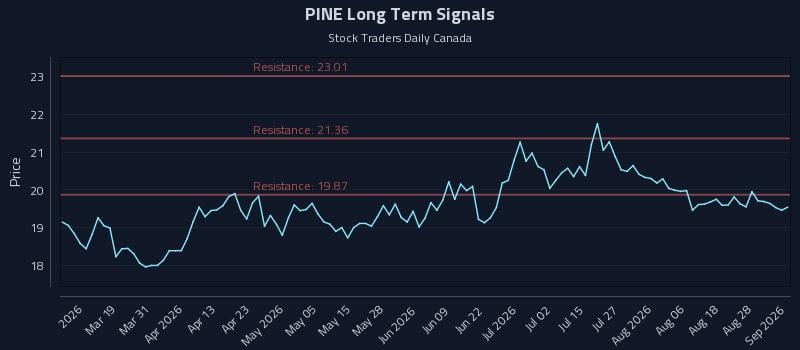
This article analyzes Alpine Income Property Trust Inc. (PINE), highlighting weak near-term sentiment and elevated downside risk despite long-term strength. It provides AI-generated trading strategies—Position Trading, Momentum Breakout, and Risk Hedging—with specific entry, target, and stop-loss points. The analysis also includes a multi-timeframe signal breakdown for near, mid, and long-term horizons, indicating divergent sentiment across these periods.
Alpine Income Property Trust, Inc. (NYSE:PINE) has received a "Moderate Buy" consensus rating from analysts, with an average 12-month price target of $21.50, exceeding its current price of $19.71. The company recently surpassed quarterly earnings expectations, reporting $0.16 EPS against a $0.14 consensus and $20.00 million in revenue compared to estimates of $18.85 million. Alpine also increased its quarterly dividend from $0.30 to $0.32 per share, resulting in an annualized dividend of $1.28 and a 6.5% yield.
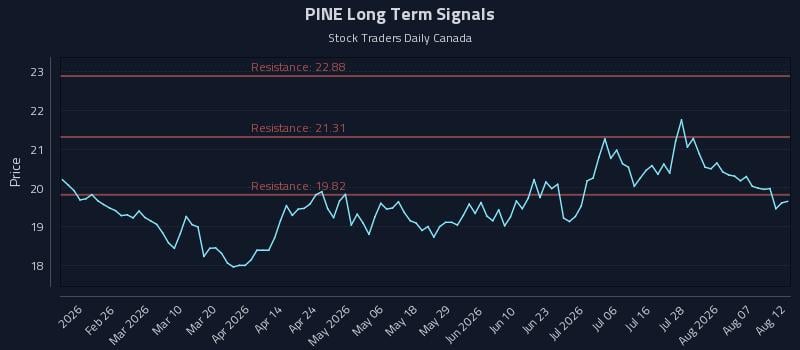
Alpine Income Property Trust Inc. (NASDAQ: PINE) is showing weak near and mid-term sentiment, potentially challenging its long-term positive outlook. The analysis indicates elevated downside risk with no clear price positioning signal identified. Three institutional trading strategies—Position Trading, Momentum Breakout, and Risk Hedging—have been generated by AI models, tailored for different risk profiles and holding periods.
Renaissance Technologies LLC significantly increased its stake in Alpine Income Property Trust (NYSE:PINE) by 87.1% in the first quarter, now owning 121,200 shares. Institutional investors collectively hold 60.5% of the company. Alpine Income Property Trust also reported strong quarterly earnings, beating analyst estimates with $0.16 EPS and $20 million in revenue, and increased its quarterly dividend to $0.32 per share, representing a 6.6% yield.
Alpine Income Property Trust (NYSE:PINE) Director Andrew Richardson sold 2,000 shares of the company's stock for $40,560, reducing his total holdings by 19.18%. This transaction comes as the company continues to outperform analyst expectations, reporting a quarterly EPS of $0.16 and revenue of $20.0 million, and has also increased its quarterly dividend to $0.32 per share, representing a 6.3% annualized yield. Analysts generally maintain a "Moderate Buy" rating for PINE, with an average price target of $21.50.

Alpine Income Property Trust Director Andrew C. Richardson sold 2,000 common shares for $40,567 on July 28, 2026, at a price of $20.28 per share. This transaction reduced Richardson's direct holdings to 8,425 shares. The information was generated by Public Technologies (PUBT) using AI based on content from the U.S. Securities and Exchange Commission's EDGAR system.