

Planet Labs PBC (PL), also known simply as Planet, is an American private Earth imaging company based in San Francisco, California. The company was founded in 2010 by three former National Aeronautics and Space Administration (NASA) scientists: Will Marshall, Robbie Schingler, and Chris Boshuizen. Planet’s mission is to image the world's entire landmass every day to bring about global change through accessible, usable satellite imagery and analytic solutions.
The company designs and manufactures Triple-CubeSat miniature satellites, also known as Doves, that are standardized to 10 cm × 10 cm × 30 cm dimensions. Their unique approach lies in these compact, cost-effective satellites that are regularly launched to continuously replenish and upgrade the "Flock" of Doves in orbit. This results in unprecedented levels of updated, real-time coverage of the globe, allowing for faster and more informed decision-making - from detecting deforestation changes to monitoring crop growth for efficient farming practices.
One of the exciting projects to emerge from Planet Labs is the Planet API, a flexible, modern API that connects developers with a wide spectrum of Planet's imagery. Access to such an extensive and continually updated dataset allows for uses across various sectors, including agriculture, environmental monitoring, humanitarian aid, defense, and intelligence.
In 2017, Planet achieved a significant milestone when it deployed 88 Dove satellites—the most by any company ever—in one go. This marked a new era of earth observation where it’s possible to monitor daily changes on our planet and respond proactively instead of retrospectively.
In recent years, Planet has made strategic acquisitions to expand its capabilities. It acquired Terra Bella, a Google subsidiary, in 2017, adding high-resolution SkySat satellites to its constellation. Also, RapidEye’s five satellites were taken over, boosting its monitoring capabilities.
Despite being a relatively young enterprise, Planet has disrupted the field of satellite imagery and geospatial data with its innovative, high-frequency, global imaging capabilities. As a Public Benefit Corporation, it aims to serve the larger good by providing nearly real-time monitoring of the Earth that can enhance our understanding of the planet, timely inform policy-makers and provide crucial data to individuals, and organizations working on socio-economic or environmental issues. Mentorship and an ethos of constant learning and innovation form the bedrock of the company culture at Planet Labs. The growth story of Planet Labs underscores the potential of space technology when paired with the vision of making a positive global impact.
Income statement
Balance sheet statement
Cash flow statement
Current assets / Current liabilities
Equity / Debt / Cash
Dividends
_07_03_2026_03_50_21_133108.jpg)
William Spencer Marshall, Co-Founder and CEO of Planet Labs PBC, reported a gift of 80,000 Class A Common Stock shares on September 18, 2026, without monetary exchange. After this transaction, Marshall still directly owns 2,488,473 Class A Common Stock shares, which includes 1,693,566 Restricted Stock Units that vest quarterly. This disclosure, made via a Form 4 filing with the SEC, highlights Marshall's continued significant ownership in the company.
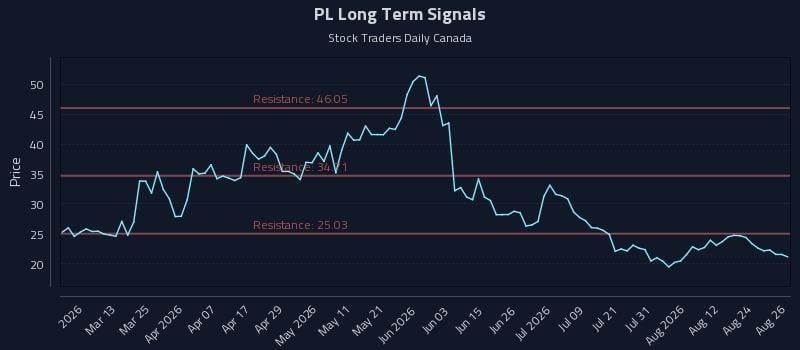
This article provides an AI-driven analysis for Planet Labs Pbc Class A (NYSE: PL), highlighting weak near and mid-term sentiment that could challenge its long-term positive outlook. It presents institutional trading strategies including position trading, momentum breakout, and risk hedging, along with multi-timeframe signal analysis indicating support and resistance levels.

Planet Labs CFO Ashley Johnson sold approximately 110,000 shares worth $2.4 million on July 23, 2026, as part of a pre-established Rule 10b5-1 trading plan. Despite the sale occurring during a stock decline, it is not seen as a red flag because Johnson retains a significant equity position, aligning her interests with shareholders. The company experienced a 226% one-year return but also reported a substantial net loss in the trailing-twelve-month period.

Planet Labs PBC's President and CFO, Ashley F. Johnson, has engaged in significant share transactions under a Rule 10b5-1 trading plan. These transactions are relevant to investors as they highlight executive actions and could impact shareholder value, reflecting changes in the management's ownership structure.