

ProPetro Holding Corp., or simply ProPetro, is a leading oilfield services company publicly traded on the New York Stock Exchange under the ticker symbol PUMP. It primarily operates in the Permian Basin, which is one of the largest and most active oil fields in the United States. The company's headquarters are located in Midland, Texas.
ProPetro was founded in 2005 and has since built a strong reputation for its efficient services and commitment to safety. The company specializes in hydraulic fracturing, or "fracking," a process used to extract oil and gas from rock formations deep underground. ProPetro also provides other complementary services, including cementing, coil tubing, flowback, surface drilling, and Permian rig services.
As of now, ProPetro operates one of the largest fleets of hydraulic fracturing units in the United States. It's noted for its superior execution, and high-quality equipment. Throughout their years of operation, they have focused on creating strong partnerships with their customers who are primarily exploration and production companies.
ProPetro's business model focuses on delivering efficient, cost-effective services for its clients, and this has set them apart in the highly competitive oilfield services industry. The company places great importance on implementing advanced technology in its operations, considering it as a key aspect of their efficiency and productivity goals.
However, the company's operations remain susceptible to fluctuations in the oil and gas industry. The demand for ProPetro's services is directly linked to the level of exploration, development, and production activity of oil and gas companies, and therefore heavily affected by changes in oil and gas prices. Regular adjustments to cope with the industry's cyclical nature are to be expected.
Under scrutiny for some past regulatory and legal issues, ProPetro has recently seen quite some management changes. The company is focused on improving and maintaining strong governance and compliance structures to respond to the challenges of their operational environment.
Nevertheless, ProPetro has proven its resilience in the face of a challenging industry environment. Despite the industry's volatility, the company has continued to deliver strong performance and value to its clients and shareholders.
In conclusion, ProPetro is a formidable player in the Oilfield Services Industry with its primary operations in the prolific Permian Basin. While challenges have tested the company, it continues to deliver solid performance through its commitment to efficiency, safety, and customer service.
Income statement
Balance sheet statement
Cash flow statement
Current assets / Current liabilities
Equity / Debt / Cash
Dividends
ProPetro Holding (PUMP) has seen its share price increase by 97.1% over the last year, leading to questions about whether its current valuation is justified by its sales. The stock trades at a P/S ratio of 1.1x, which is similar to the broader Energy Services industry but higher than its direct peer set. Analysts and community narratives offer differing views on the company's valuation, with some suggesting it is overvalued based on current sales and others pointing to future growth opportunities.
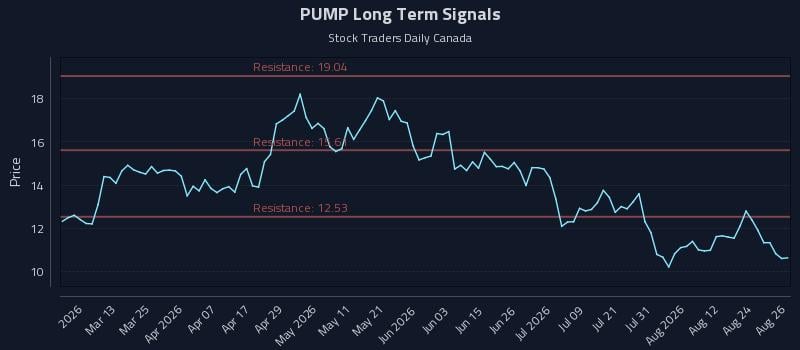
This article analyzes Propetro Holding Corp. (NASDAQ: PUMP) using AI models to generate trading strategies. It highlights weak near-term sentiment but strong long-term prospects, with no clear price positioning signal identified and elevated downside risk. The analysis provides specific entry and target points for position trading, momentum breakout, and risk hedging strategies.
Assenagon Asset Management S.A. has acquired 1,304,055 shares of ProPetro Holding Corp. (NYSE:PUMP) for approximately $18.7 million, securing a 1.06% stake. This comes amidst other institutional investor activities, while company insiders like COO Adam Munoz and Director G. Larry Lawrence have recently sold significant portions of their holdings. ProPetro missed its Q2 earnings estimates, reporting a loss of $0.07 per share against an expected $0.01, and revenue declined 6.3% year-over-year.