

Roblox Corporation, known by its ticker as RBLX, is a premier online entertainment platform that allows users to connect, create, and play together in shared virtual 3D worlds. Developed in 2004 and officially launched in 2006 by David Baszucki and Erik Cassel, Roblox has swiftly become a popular hub for users of all ages, especially among children and teenagers.
Roblox functions as a unique blend of a gaming and social networking platform. On one hand, users can design their own interactive 3D games using its proprietary platform, Roblox Studio, while on the other hand, users can engage with millions of other users by playing the user-generated games. The company's platform operates under the freemium model, where the primary product is free, but users have the option to purchase virtual currency - known as "Robux" - to buy in-game accessories and avatars.
One distinctive feature of Roblox is that it fosters creativity and entrepreneurship among its youthful users. The Roblox Developer Exchange Program allows developers to exchange Robux earned from their games into real-world currency, providing a platform for young developers to monetize their creation effectively.
Touting itself as the “Imagination Platform,” Roblox has grown impressively over the last decade, amassing millions of daily active users. In 2020, according to Business of Apps, the company reported that half of all American under the age of 16 had played Roblox. This firmly establishes the unique position Roblox Corp has in the games and social networking industry.
On March 10, 2021, Roblox Corp went public via a direct listing on the New York Stock Exchange under the ticker symbol "RBLX". At the close of the first day of trading, its market capitalization had ballooned to around $38.26 billion. This immense success underlines the popularity and rapid growth of the Roblox platform.
Despite its success, Roblox Corp has faced criticism and controversies, primarily concerned with the safety measures for younger players, its monopoly shaping practices, and its revenue sharing model with developers.
As of now, Roblox Corporation remains a pivotal player in the gaming industry. With its unique business model and continuous adaptation to evolving user demand, it is expected to maintain its growth trajectory in the foreseeable future.
Income statement
Balance sheet statement
Cash flow statement
Current assets / Current liabilities
Equity / Debt / Cash
Dividends
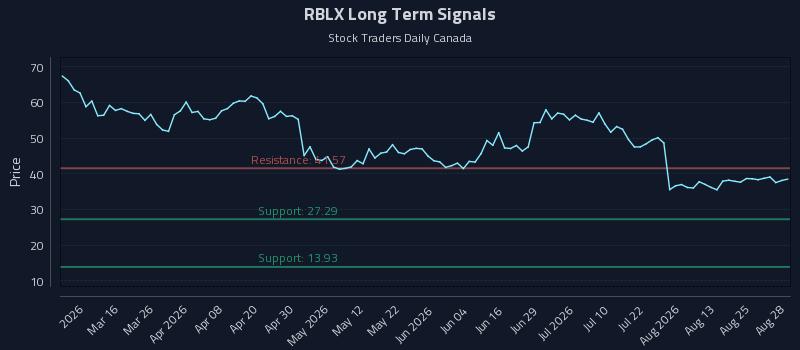
The article analyzes Roblox Corporation Class A (RBLX) using AI models, revealing mixed sentiment and a mid-channel oscillation pattern. It presents three institutional trading strategies (Position, Momentum Breakout, Risk Hedging) tailored for different risk profiles. The analysis also includes multi-timeframe signal analysis, showing varying signal strengths across near-term, mid-term, and long-term horizons.

Quantitative Investment Management LLC significantly reduced its stake in Roblox Corporation (RBLX) by 78.3% in the second quarter, selling 76,947 shares. Despite the sale, institutional investors and hedge funds collectively own 94.46% of RBLX. Roblox reported a narrower-than-expected quarterly loss but missed revenue estimates, though revenue increased year-over-year, and the company authorized a $3 billion share-repurchase program.

Sean Jack Buckley, Chief People & Systems Officer at Roblox Corporation, sold 4,321 shares of Class A common stock for approximately $167,136. This transaction was conducted on August 24, 2026, under a pre-arranged Rule 10b5-1 trading plan adopted in November 2025. Despite the sale, Buckley retains 87,213 shares, and the article suggests this move should not alarm investors as he sold only a small percentage of his holdings, implying continued confidence in the company.

The Gross Law Firm has issued an alert to shareholders of Roblox Corporation (NYSE: RBLX) regarding a securities class action lawsuit. The lawsuit alleges that Roblox made materially false and misleading statements about its organic growth potential, particularly concerning a slowdown in growth rates due to an age verification rollout. Following the announcement of Q1 2026 financial results and reduced guidance, Roblox's stock price dramatically declined.