

Wayfair Inc., often simply referred to as Wayfair, is a leading American e-commerce company with a distinct specialization in furniture and home goods retailing. Its headquarters is located in Boston, Massachusetts but its global footprint is undeniable with operations across North America and Europe. The company is publicly traded on the New York Stock Exchange under the ticker symbol W.
Wayfair Inc. was founded by engineers Niraj Shah and Steve Conine in 2002. The business began as a small two-person operation, initially going by the name CSN Stores. The venture was based on a simple but revolutionary idea: harnessing the potential of internet technology to sell furniture. As e-commerce grew exponentially, so did Wayfair, which rebranded from CSN Stores in 2011.
Wayfair's digital platform boasts an extensive product selection of more than 14 million items across diverse home categories including furniture, décor, home improvement, household goods, and more. This vast assortment of products comes from more than 11,000 global suppliers.
The company’s strategy of offering a high degree of variety, along with affordable pricing, has made Wayfair one of the go-to online destinations for home goods shopping. Additionally, Wayfair’s commitment to enhancing the customer experience with dynamic tech-forward features, such as a mobile app with 3D visualization, helps it stand out in the crowded e-commerce space.
Wayfair’s growth has been meteoric. The company went public in 2014, and as of 2020, Wayfair’s consolidated net revenue exceeded $14 billion. It also boasts a customer base of over 31 million active customers, a testament to its popularity and market reach.
However, like any company, Wayfair has faced its share of challenges. It has grappled with profitability issues and faced intense scrutiny over its business practices. It has been criticized over worker conditions, direct-to-consumer marketing strategies, and faced allegations related to the sale of children's furniture.
Despite these challenges, Wayfair has continued to innovate and expand its business. It has continued its push into brick-and-mortar retail with Wayfair Spaces, an immersive design experience featuring innovative uses of technology such as virtual reality. In a nutshell, Wayfair Inc. offers an excellent case study of a company harnessing the potential of digital technology to redefine, improve, and modernize the home goods shopping experience.
Income statement
Balance sheet statement
Cash flow statement
Current assets / Current liabilities
Equity / Debt / Cash
Dividends

Wayfair (W) shares recently surged by 30% after positive second-quarter earnings, driven by cost-cutting and advertising, but Morningstar analysts remain cautious. Despite these gains, the stock is still down 5.9% for 2026 and is considered overvalued due to intense competition and a lack of sustained profitability compared to peers. The article suggests that investors may be overly optimistic about Wayfair's long-term growth prospects.
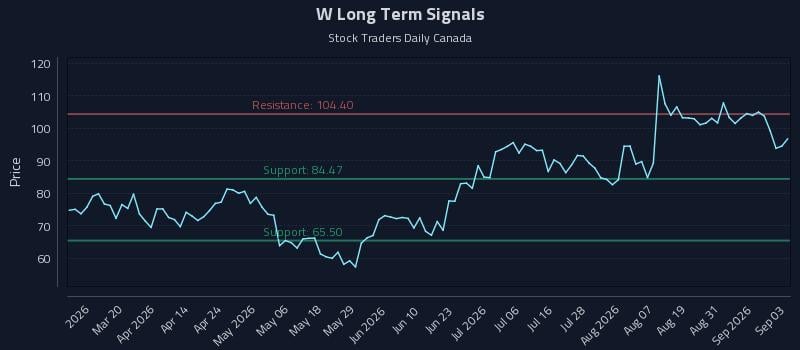
This article analyzes Wayfair Inc. Class A (NYSE: W) using AI models, highlighting weak near and mid-term sentiment and a neutral long-term outlook. It details three trading strategies—Position Trading, Momentum Breakout, and Risk Hedging—alongside multi-timeframe signal analysis and risk-reward ratios. The analysis emphasizes the importance of AI-driven insights for optimizing position sizing and managing drawdown risk.

Two analysts have issued bullish sentiments on CAMP4 Therapeutics Corporation (CAMP) and Wayfair (W). William Blair analyst Myles Minter reiterated a Buy rating for CAMP4 Therapeutics, while Bernstein's Nikhil Devnani upgraded Wayfair to Buy with a price target of $125. Both companies show strong analyst consensus, with CAMP4 having a "Strong Buy" and Wayfair a "Moderate Buy."
Wayfair director Steven Conine sold 68,999 Class A common shares for approximately $7.11 million on August 12, 2026. The sales were executed at weighted-average prices between $101.98 and $105.42. Following these transactions, Conine's direct stake in Wayfair fell to 360,073 shares, with an additional 22,857 shares held indirectly through SK Ventures LLC.

Wayfair is experiencing profit expansion due to leveraged expenses on sales acceleration, operating in a fragmented home goods market with a vast product offering. Despite its broad product range and logistics network, the company faces challenges with brand strength, high advertising spending, and intense competition, leading to a no-moat rating. Analysts remain cautious about its stock despite potential for faster sales growth.
Morgan Stanley has increased its target price for Wayfair Inc. (W.N) shares to $145 from the previous $110. This adjustment reflects an updated outlook from the financial services firm regarding the e-commerce furniture and home goods retailer.