

Sempra Energy, traded as SRE (Sempra Energy Stock) on the New York Stock Exchange, is an American leading energy-infrastructure company. Based in San Diego, California, Sempra Energy provides a broad spectrum of energy services to over 40 million consumers worldwide. Established in 1998, the company today is a significant participant in the global energy market, with an estimated market capitalization exceeding $30 billion and annual revenues above $10 billion.
Even though Sempra Energy is diversified into multiple energy sectors, it primarily operates through two main subsidiaries: San Diego Gas & Electric (SDG&E) and Southern California Gas Company (SoCalGas). SDG&E is a regulated utility company, providing electricity and natural gas to about 3.6 million consumers in San Diego and the southern Orange Counties. SoCalGas, on the other hand, is the largest natural gas distributor in the United States, serving more than 21 million customers across Southern California.
Being a future-focused energy company, Sempra Energy has strategically invested in renewable energy, natural gas, and infrastructure projects tackling the challenge of the transition to a low-carbon energy economy. The company holds significant natural gas storage facilities, transmission pipelines and engages in the development of liquefied natural gas (LNG) export facilities. Sempra Energy's goal is to lead the way to a sustainable energy future by enabling the delivery of net-zero emissions energy to the global market.
Furthermore, Sempra Energy has a strong commitment to corporate responsibility, striving to balance the needs of its stakeholders with its operational priorities. The company enforces high standards for safety, environment preservation, and corporate governance while also focusing on community development.
Sempra Energy's robust financial performance, diverse energy portfolio, and its commitment towards future energy solutions signify its prominent position in the energy sector. It is not only a substantial player in the domestic market but also leaving a footprint in Mexico and South America's energy infrastructure. Acknowledged for its operational excellence, Sempra Energy has been repeatedly recognized with accolades and awards, solidifying its reputation as an innovative leader in the global energy market.
With unparalleled commitment towards clean energy, infrastructure expansion, and customer satisfaction, Sempra Energy continues to deliver reliable energy services while striving to meet the growing energy demands of the modern world.
In summary, Sempra Energy is a symbol of innovative energy solutions, reliable services, environmental stewardship, and steadfast dedication to forging a future of clean and sustainable energy.
Income statement
Balance sheet statement
Cash flow statement
Current assets / Current liabilities
Equity / Debt / Cash
Dividends

Sempra's Oncor, a Texas utility, is finalizing a 20% increase to its capital spending plan, which will bring its 2026-2030 capex to over $47.5 billion, driven by data center growth and other requests. Similarly, Pinnacle West Capital Corp., parent of Arizona Public Service, also raised its sales growth outlook through 2030, expecting energy needs to double by 2041 due to economic expansion, including data centers and manufacturing. Both utilities highlight the diversity of load growth beyond just data centers.
Candriam S.C.A. acquired 92,840 shares of Sempra Energy (NYSE:SRE) in the third quarter, a new stake valued at approximately $7.26 million, contributing to institutional investors' 89.65% ownership of the stock. Sempra Energy reported strong quarterly EPS of $1.40, surpassing analyst estimates, despite revenue of $3.19 billion coming in below expectations. The company also announced a quarterly dividend of $0.6575 per share, an annualized dividend of $2.63, reflecting a 3.3% yield and a payout ratio of 56.32%.
Alps Advisors Inc. recently purchased 53,774 shares of Sempra Energy (NYSE:SRE) worth approximately $4.2 million in the third quarter, making them a new significant institutional investor. Other major institutional investors also acquired new positions in the company, with collective institutional ownership reaching 89.65%. Sempra Energy reported quarterly EPS of $1.40, surpassing analyst estimates, although revenue of $3.19 billion fell short of expectations.
Sempra Energy (NYSE:SRE) reported adjusted EPS of $1.40 for the third quarter, surpassing analyst estimates by $0.18 and marking a 26% increase year-over-year. Although revenue of $3.19 billion missed estimates, the company expects to reach the high end of its 2026 EPS guidance and reaffirmed its 2027 outlook, despite a potential regulatory decision affecting 2027 California segment earnings. The utilities provider also announced a 20% increase in Oncor’s 2027–2031 capital plan and confirmed an upcoming dividend payment.

Sempra stock (SRE) fell by 2.08% to $78.17 on Friday, marking its fifth consecutive day of losses. This occurred during a mixed trading session where the S&P 500 Index rose 0.31%, while the Dow Jones Industrial Average declined 0.46%.

Sempra reported strong third-quarter 2026 adjusted EPS of $1.40, a 26% year-over-year increase, driven primarily by growth in its Texas operations. The company is guiding towards the high end of its 2026 adjusted EPS range and affirming its 2027 EPS guidance, with management highlighting an expected 20% increase in Oncor's base capital plan to address grid reliability and robust demand. Sempra is also simplifying its business model, focusing on regulated utilities and using capital recycling to strengthen its balance sheet, despite facing potential regulatory headwinds in California.
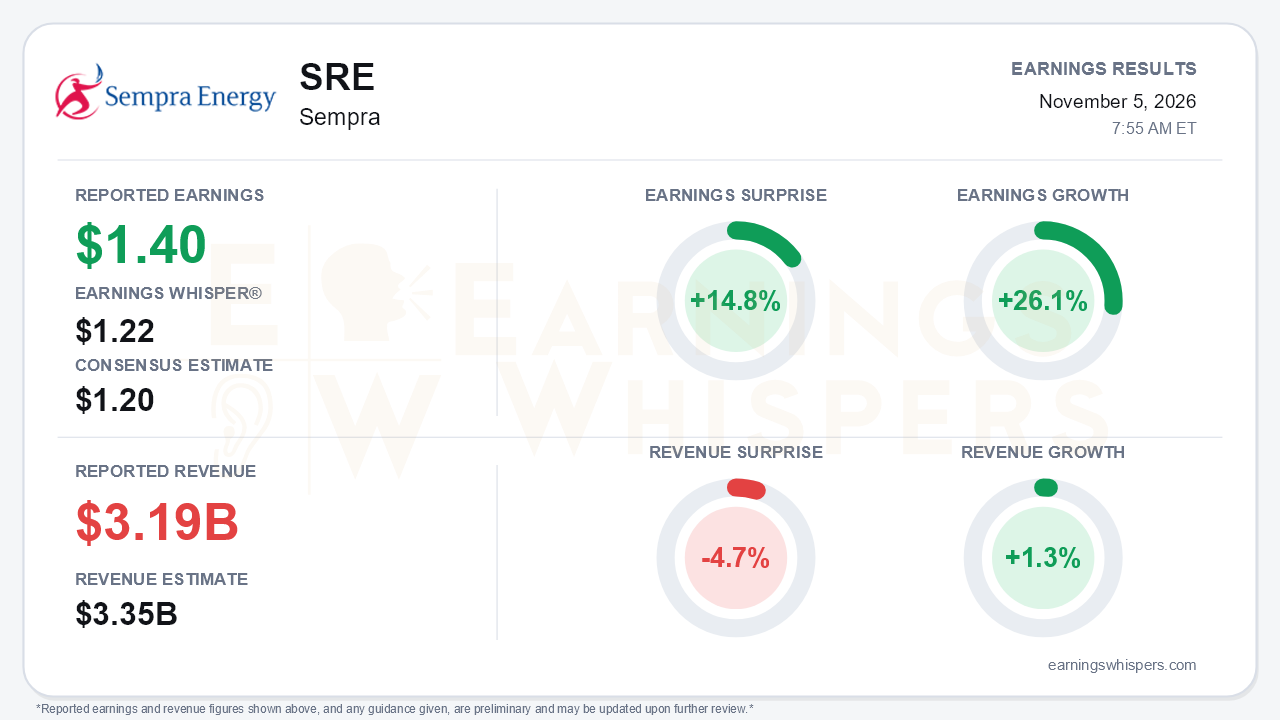
Sempra (NYSE: SRE) reported adjusted earnings of $1.40 per share, significantly beating the $1.20 consensus, driven by strong performance in its Sempra Texas Utilities segment. While this led management to guide 2026 adjusted EPS to the high end of its range, a regulatory setback in California for 2027 casts a shadow, potentially pushing 2027 EPS guidance to the lower half of its range. The company's future growth hinges on increased capital opportunities in Texas, though political and regulatory uncertainties in both states remain.